
 By

It starts as white thread softer than cotton. It ends as this.
The carbon fiber hood on a show car and a spool of soft white thread have something in common: they are the same material, separated by about two thousand degrees and a great deal of patience. The journey from one to the other is stranger than most people expect. Part chemistry experiment, part blacksmithing, part watchmaking. Here is how it actually happens.
Act One: the White Thread
Carbon fiber begins as PAN, polyacrylonitrile, a white polymer thread similar to acrylic yarn. Thousands of these filaments, each thinner than a human hair, are bundled into a tow. At this stage you could knit with it. Nothing about it hints at what is coming, and that is the first surprise of the process: carbon fiber is not found or refined. It is transformed.
Act Two: the Slow Burn
The transformation happens in two ovens. First, stabilization: the threads are heated in air to around 200 to 300 degrees Celsius, which rearranges their molecular structure so they can survive what comes next. Then carbonization: in an oxygen-free furnace at 1,000 to 1,500 degrees, everything that is not carbon is driven off. Hydrogen, nitrogen, oxygen, gone. What remains is a fiber that is more than 90 percent pure carbon, black as charcoal and, weight for weight, stronger than steel. The full carbon fiber manufacturing process walks through each stage with the numbers attached.
The temperatures cannot be rushed, and this is worth understanding. Heat the threads too fast during stabilization and the fibers fuse together or snap; the ramp from room temperature to final heat is measured in hours, not minutes, and it is controlled to the degree. The furnaces run continuously, chains of them, each zone a little hotter. Fiber that enters white and soft exits black and brittle. And finally worthy of the name.
After the ovens comes an unglamorous but crucial step: surface treatment and sizing. The raw carbonized fiber is smooth and chemically aloof. It does not naturally bond well to resin. A surface treatment roughens it microscopically, and a coating called sizing is applied to protect the filaments and help the resin grip later. Skip or cheap out on this stage and the strongest fiber in the world will still peel out of its matrix under load. Strength is a team sport, and the bond is a player.
Only now can the fiber be woven into the fabrics everyone recognizes. Plain weave, twill, the familiar checkerboard shimmer. Every yard of that fabric carries the memory of those ovens. The black is not a dye. It is the scar of the transformation.
Act Three: the Mold
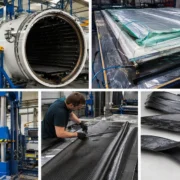
Fabric alone is a tablecloth. To become a part, it needs shape and a spine. The fabric is cut to patterns, laid into a mold, sometimes by hand, layer by layer, with each ply oriented for the loads the part will carry, and saturated with epoxy resin. Then comes consolidation: vacuum, pressure, heat, depending on the process, squeezing out air and excess resin until fiber and matrix become one solid laminate.
This is the stage where quality is decided and where corners get cut. Air trapped between layers becomes a void, and a void becomes a crack waiting for an excuse. Resin-rich corners add weight without strength. The difference between a part that lasts a decade and a part that fails in a season was usually settled here, invisibly, inside the mold.
Act Four: the Finish
Out of the mold, the part is trimmed, drilled, sanded, and clear-coated. The clear coat is not vanity, it is UV armor for the resin underneath, the difference between a part that yellows in two summers and one that stays deep black for ten years. Finish options, gloss, matte, satin, tints. All live at this station too, and the carbon fiber color options guide shows what each looks like in finished form. Then inspection, and only then, a box with your name on it.
Why the Journey Matters to a Buyer
Every step in this journey is a place where money can be saved or quality can be built. Cheap parts skip time in the oven, rush the layup, thin the clear coat. Good parts do none of that, and the price difference is simply the receipt for the difference. When you understand the journey, the price stops being a mystery and starts being a map.
It also explains the lead times that frustrate first-time buyers. A part can only move through these stages as fast as chemistry and physics allow. Ovens ramp on their own schedule, resin cures on its own clock, clear coat dries when it dries. The eight-week wait for a quality hood is not poor planning. It is the journey, refusing to be hurried.
The next time you run a hand over a carbon weave, remember: it was soft white thread once. Everything you are touching, the black, the strength, the shimmer, was earned in an oven, a mold, and a spray booth. That is not marketing. That is just what it takes.










Comments